



















Why is AI infrastructure website design different?
AI infrastructure website design is different because the product is invisible and the buyer is technical. There's no interface to screenshot for a GPU cluster, an inference API or a feature store, and the person evaluating it will judge the site by whether the claims survive a quick test. Vague copy reads as a warning sign, not as ambition.
The category also looks the same from the outside. Many GPU clouds and model-serving platforms describe themselves in near-identical words: fast, scalable, cost-effective. When every site makes the same three claims, the buyer compares on price alone. The site's job is to name the specific trade-off you win on, such as cold-start time, a particular hardware mix, data residency or a simpler deployment model, and then prove it.
In a Crazy Egg study cited in our research, 97% of respondents saw benefits in AI tools but only 45% said they would try one. Infrastructure buyers are, if anything, more skeptical than that, because a bad choice means a migration later. Our guide to developer tools website design covers the developer-facing side of this in more depth.
Who is an AI infrastructure website actually selling to?
Most AI infrastructure sites sell to two people at once: the engineer who tries the product and the budget owner who signs for it. They read different pages and ask different questions, so the site needs a clear path for each instead of one message that half-serves both.
Reader | What they check first | What convinces them |
|---|---|---|
ML or platform engineer | Docs, quickstart, SDKs, supported models and hardware | Working code, honest limits, a fast first run |
Engineering lead or CTO | Architecture, reliability, lock-in, migration effort | Diagrams, uptime history, export paths |
Finance or procurement | Pricing unit, commitments, invoices | A price they can model before talking to sales |
Security reviewer | Data handling, isolation, compliance | A trust page with the certifications you actually hold |
We usually design the home page for the engineer and give the other three readers their own pages, linked from the navigation and the footer. Our piece on technical vs business buyers explains how to split one site between them without diluting either.
What pages does a GPU cloud or MLOps website need?
A GPU cloud or MLOps website needs a home page that shows the product working, a docs entry point, a pricing page in real units, benchmarks with methodology and a security page. Everything else can wait until you have more products or segments. This is the structure we start from before cutting it to fit.
- Home: the one trade-off you win on, a code snippet or deploy command, and two clear actions such as start building and talk to an engineer.
- Docs and quickstart: often a separate docs site, but the marketing site should link to it in one click and show the first steps inline.
- Pricing: the billing unit, what it includes and a simple estimator if usage varies. Our guide to the usage-based pricing page covers the patterns.
- Benchmarks: results with the hardware, model, batch size and date stated, so an engineer can reproduce them.
- Security and trust: isolation, data handling, regions and certifications. See our outline of a trust center page.
- Use cases or solutions: training, fine-tuning, inference or batch jobs, each with its own example.
The Evil Martians study of 100 developer-tool landing pages, named in our research, found a common pattern: a centred hero, a code snippet or product UI visual, a specific action like start building, docs or GitHub as the second action, and pricing on its own page. Infrastructure buyers expect that pattern, so we treat it as a baseline and differentiate in the message, not the layout.
How do you show an infrastructure product that has no interface?
You show what the engineer does and what they get back: the command, the config, the response and the dashboard that reports on it. A short sequence of real code, a terminal output and a metrics view explains an inference API better than any abstract illustration of glowing servers.
We design these as styled, readable code blocks and simple architecture diagrams that match your actual system. The diagram should show where the customer's data goes, what runs in their account versus yours, and what they'd need to change to leave. That last point matters: showing an export path lowers the perceived risk of trying you. Our guide to developer docs design covers how the docs and the marketing site should share components.
How should AI infra branding work in a crowded category?
AI infra branding should make you recognizable without looking like a poster for the future. The category leans on the same visuals: dark backgrounds, neon gradients, abstract chips and particle fields. They signal compute, but they don't tell an engineer anything about you, and they make every company look like the next one.
We build the identity around something specific to the product: the shape of your architecture, the way your CLI output reads, or the one number you're known for. The system then has to work in places marketing teams forget, such as docs, status pages, code blocks, error messages and conference booths. Our article on developer tools branding goes through those touchpoints.
What related work have we done?
We haven't built a site for a GPU cloud, and we won't claim one. Our closest work is for AI and data products that sell to technical and non-technical buyers at once. For Minexa.ai, a web-data extraction product with a Chrome extension and an API, we designed and built a product-led site with one core workflow and separate paths for the extension and the API, so developers and business users each found their route.
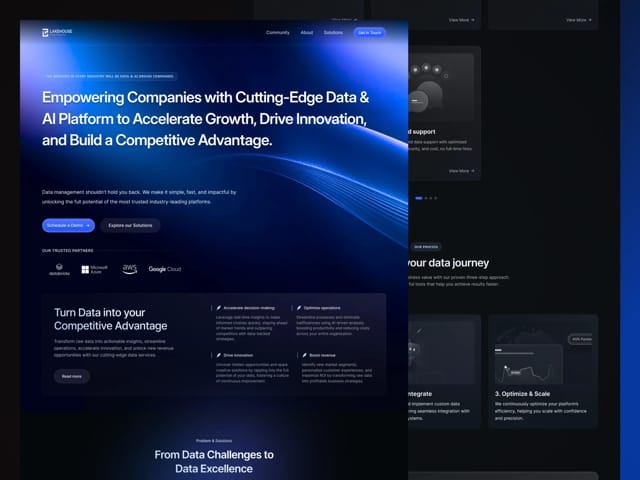
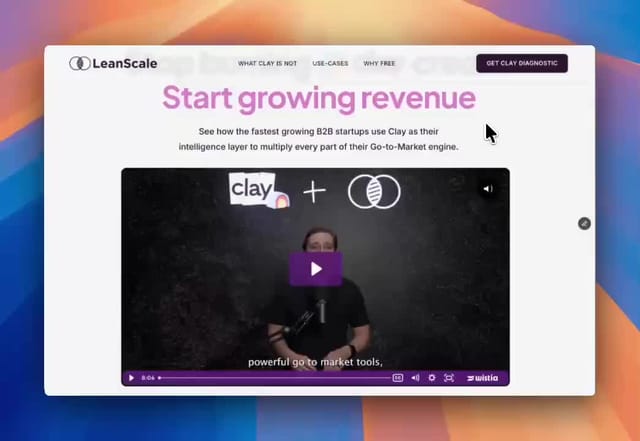
For Lakehouse Partners we designed and built a multi-page site that turns complex data and AI services into a clear path for buyers. For LeanScale, a data company, we built an education-first funnel around one free diagnostic. The common problem in all three is the one infrastructure companies face: explaining something technical clearly enough that the right buyer takes the next step.
How does our process work for an AI infrastructure startup?
Intro call
A free 30-minute call to understand the product, who buys it and where the current site loses them. We tell you whether a landing page, a full site or a trial week fits.
Words first
We interview your engineers and write the positioning and page copy before any layout: the trade-off you win on, the proof for it and the limits you state up front.
Proof inventory
We collect the code samples, benchmarks, architecture details and certifications you can stand behind, and agree what's ready to publish.
Design
Custom design in Figma: code blocks, diagrams, pricing tables and a visual identity that works on the site and in your docs.
Build
We build in Next.js with a CMS for changelog entries, benchmarks, use cases and blog posts, so your team can keep technical pages current.
Launch and handover
We run launch checks, including SEO basics and AI-crawler access, and show your team how to update the site as the product ships.
A hypothetical home page for an inference platform
For example, suppose a seed-stage startup runs open-weight models on its own GPU fleet and wins on cold-start time. The hero states that one trade-off in a sentence, followed by a three-line deploy command and the response it returns. Below it: a benchmark chart with the hardware, model and date in the caption, a pricing preview in the billing unit the product actually uses, and a short architecture diagram showing what stays in the customer's cloud. The primary action is start building; the secondary is talk to an engineer. This is an illustration of the structure, not a real client.
What does an AI infrastructure website cost?
Our website package is $8,000, fixed, for up to six pages, then $500 per extra page. That covers the copy, custom design, a Next.js build, a CMS and animation. If you need one page for a launch, a waitlist or a new product line, our landing page is $6,000. For ongoing pages, docs design and product UI, the retainer is $6,000 a month.
- Website, up to 6 pages, copy to Next.js build
- $8,000
- Single landing page for a launch
- $6,000
- Trial week before you commit
- $1,000
For context, typical ranges we see quoted for Next.js agency builds run from about $20,000 to $120,000, and they vary a lot with scope. Timelines depend on how much of the technical story already exists, so we scope them on the intro call. If your product sells mainly to developers, our devtools industry page covers docs-led growth in more depth, and our Next.js development page explains the build. The next step is a free 30-minute call.