



















What does a proptech design agency do differently?
A proptech design agency designs for software buyers in real estate, not for people browsing homes. That changes almost everything. A brokerage website sells listings and agents. A real estate software website sells time saved, fewer errors and better data to someone who runs buildings, deals or a team of agents, and who has to justify the switch to an owner or a partner.
The category also has a visual habit that works against you: skylines, keys, house icons and smiling couples in front of a front door. Those images say 'real estate' but they don't say what your software does. Your buyer already knows they're in real estate. They want to see the rent roll, the maintenance queue or the deal pipeline, and to understand how your product changes their week.
Our guide to proptech website design that makes real estate software feel trustworthy covers the topic in depth. This page covers how we approach the work and what it costs.
Who is a real estate software website selling to?
A real estate software website usually sells to one role and has to satisfy two or three others. A property management platform is chosen by an operator, approved by an owner, and then used by tenants who never chose it. A brokerage tool is bought by a team lead and used by agents. An investment platform is read by analysts and judged by partners.
Role | What they care about | What the site should show |
|---|---|---|
Property manager | Hours saved on rent, maintenance and leasing | The daily workflow, portfolio-size fit, migration support |
Owner or asset manager | Reporting, occupancy and cost control | Owner reports and dashboards, with sample data |
Broker or team lead | Agent adoption, lead flow, compliance | Agent experience, CRM and MLS connections, onboarding |
Developer or investor | Deal speed, underwriting and investor updates | Pipeline and reporting views, data handling |
Tenant or resident | Paying rent and getting things fixed | The resident app, briefly, as proof of adoption |
We give the main buyer the homepage and give each other role its own page, linked early in the navigation. If you sell into one niche of real estate, our guide to vertical SaaS websites that sell to one industry explains why speaking the trade's language matters more than a broad feature list.
How do you show proptech software without a stock skyline?
Show the screen where the work happens, with realistic sample data, and caption it with the job it does. A maintenance queue with requests sorted by urgency, a lease renewal flow, an owner statement or an underwriting model says more in a second than any hero photo of a building.
- Use believable sample data: unit numbers, rent amounts and addresses that look real but are clearly made up, never a real tenant's details.
- Crop to the decision: zoom into the part of the dashboard where a manager acts, not the whole screen.
- Show the mobile side: many property teams work on site, so show the field app if you have one.
- Keep photography for context: real buildings your customers manage, with permission, beat generic stock.
If the product is complex, a short guided walkthrough or a clickable demo can replace a sales call for early-stage buyers. Our article on property management software dashboard design covers how to make the dashboard itself readable, which also makes it work as a marketing visual.
What compliance issues affect a proptech website?
Proptech sites touch the same rules as the real estate industry they serve, and some add rules of their own. Housing-related advertising in the US falls under the Fair Housing Act, so listing tools, tenant-facing pages and any targeting or screening features need careful wording. Platforms that broker deals may need broker licence disclosures, and listing data from an MLS usually comes with display rules set by that MLS.
- Fair housing: avoid language and imagery in listings tools, resident pages and ads that could signal a preference for or against protected groups.
- Broker disclosure: if you or your customers act as brokers, show licence information where the rules require it.
- Listing data: follow the display and attribution rules in your MLS or data-provider agreement.
- Tenant data: describe how you handle screening and payment data in plain words, and link to the full policies.
- Accessibility: tenant and applicant flows should be usable with a keyboard and a screen reader.
These rules vary by state and by data agreement, so treat this as a list of questions for your counsel. Our guide to real estate website compliance covers Fair Housing, broker disclosure and accessibility in more detail.
What pages does a property management software website need?
A property management software website needs pages that answer fit, workflow, cost and switching. Operators want to know quickly whether you handle their portfolio type and size, and what it takes to move off their current system.
- Home: the main job you do, for which portfolio types, shown in the product.
- Solutions by portfolio: residential, commercial, student housing, HOA or short-term rental, one page each, only for the ones you serve.
- Product pages: leasing, rent collection, maintenance, accounting and owner reporting, one per job.
- Pricing: per unit, per door or per seat, with a worked example for a typical portfolio.
- Integrations: accounting, payments, listing sites and screening providers you connect to.
- Switching: what data moves across, how onboarding works and who helps.
- Security and trust: how tenant and payment data is protected, and audits you hold today.
If you sell mainly through demos, our guide to sales-led SaaS websites built for demo requests shows how to design the demo path so it doesn't feel like homework.
Hypothetical example: restructuring a proptech homepage around one buyer
For example, suppose a property operations startup has a homepage that addresses 'landlords, tenants, agents and investors' in the same headline. Each visitor reads it as not quite for them.
The redesign picks the buyer who signs the contract, mid-size residential property managers, and writes the headline for their main pain, maintenance requests lost across email and texts. The hero shows the maintenance queue. Owners, residents and vendors each get a short section linking to their own page. This is an illustration, not a real company's site or results.
What should proptech branding look like?
Proptech branding should look like dependable operating software first and real estate second. The buyer is trusting you with rent, leases and owner money, so the identity should feel precise and steady. Real estate cues can come through photography and language rather than a house-shaped logo.
The brand also has to work in places a property team sees often: tenant portals, owner statements, emails and maybe a resident app carrying your name or theirs. If your customers white-label the resident experience, design the brand system so it can step back gracefully. Our guide to real estate branding covers the brokerage side, which helps if you sell to brokers.
What real estate work have we done?
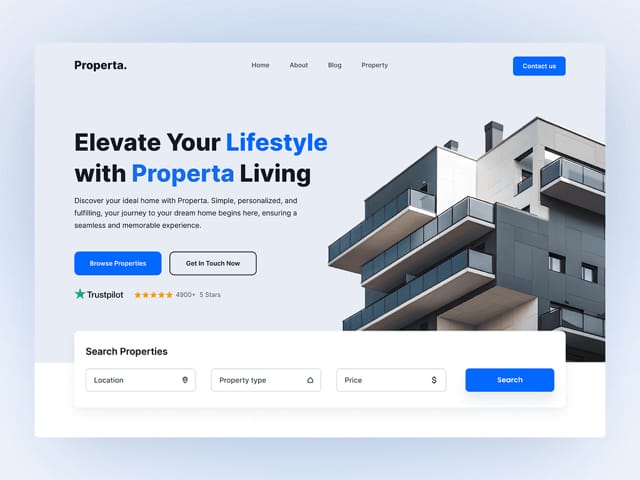
We designed the Properta landing page, for a brand that helps people find their dream home. The work was landing page design: a clear, inviting page for home seekers.
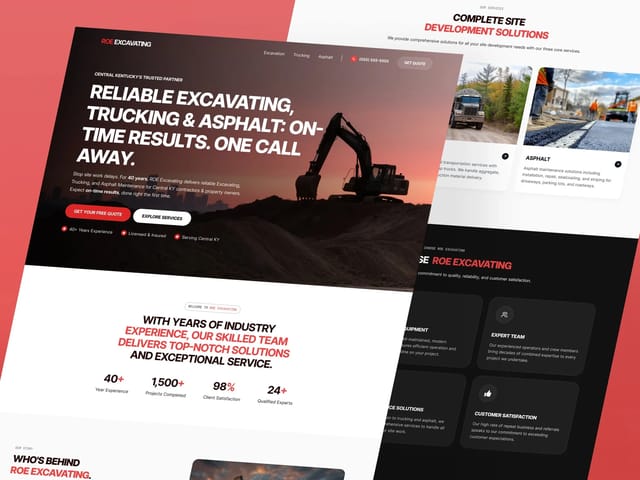
We also designed and built the website for ROE Excavating, a contractor serving contractors and property owners in Central Kentucky. Both projects meant making a property-related service clear and trustworthy to a practical buyer. For proptech, we bring that together with the SaaS work we've done on product-led sites, shown on our B2B SaaS industry page.
How does our process work for a proptech startup?
Intro call
A free 30-minute call about your product, your buyer, the roles around them and your current site.
Positioning and copy
We pick the lead buyer, write the homepage and role pages, and draft plain-language compliance and data statements for counsel.
Brand
A refresh or new identity that reads as operating software, with a system that can work inside tenant and owner touchpoints.
Design
Custom Figma design for the home page, role or portfolio pages, product pages, pricing and the switching page.
Build
A Next.js build with a CMS, product visuals with realistic sample data, and demo or signup forms wired to your CRM.
Launch
Demo and signup tracking, SEO checks, an accessibility pass on key flows, and a handover to your team.
What does a proptech design agency cost?
Our website package is $8,000, fixed, for up to six pages, then $500 per extra page. It includes copy, custom design, the Next.js build, a CMS and animation. If the brand needs work first, our brand and design sprint is $3,000 for a brand refresh or redesign plus ten website or product explorations in Figma. For dashboard and app design, the monthly retainer is $6,000 a month.
- Website, up to 6 pages
- $8,000
- Brand and design sprint
- $3,000
- Ongoing product and site work
- $6,000/mo
Timelines are scoped on the intro call. If you want to test working with us first, the trial week is $1,000 for one week of design and development. Our real estate website cost guide covers typical market ranges for comparison.
The next step is a free 30-minute call. Bring your current site, a product demo and a sense of who signs the contract.